Maturation and sensory hair cell regeneration potential
In humans, as with all mammals, the loss of auditory sensory hair cells is irreversible. However, different degrees of hair cell regeneration occur in vestibular sensory epithelia, at early developmental stages, or in non-mammalian species. Hair cell regeneration results from division and/or trans-differentiation of neighbouring supporting cells. It is generally accepted that poor, or absent, hair cell regeneration relates to the differentiation state reached by supporting cells and hair cells, but the mechanisms behind this are unknown.
What dictates hair cell regeneration potential? Taking on a multi-layered approach, combining single-cell multi-omics, spatial transcriptomics and transcriptional manipulations, we are studying the vestibular utricle to evaluate the connection between maturation and HC regeneration potential.
We are taking on a comparative approach to identify the cell/tissue level factors that interact during maturation to distinguish the mouse (marginally-regenerating) and chick (fully-regenerating) utricle. Additionally, we are studying the regeneration trajectories of postnatal and adult mouse utricle to zoom-in on the factors driving the age-related decrease in regeneration potential. Finally, our aim is to perform simultaneous transcriptional manipulation of identified targets aiming to overturn the poor HC regeneration of the adult mammalian utricle.
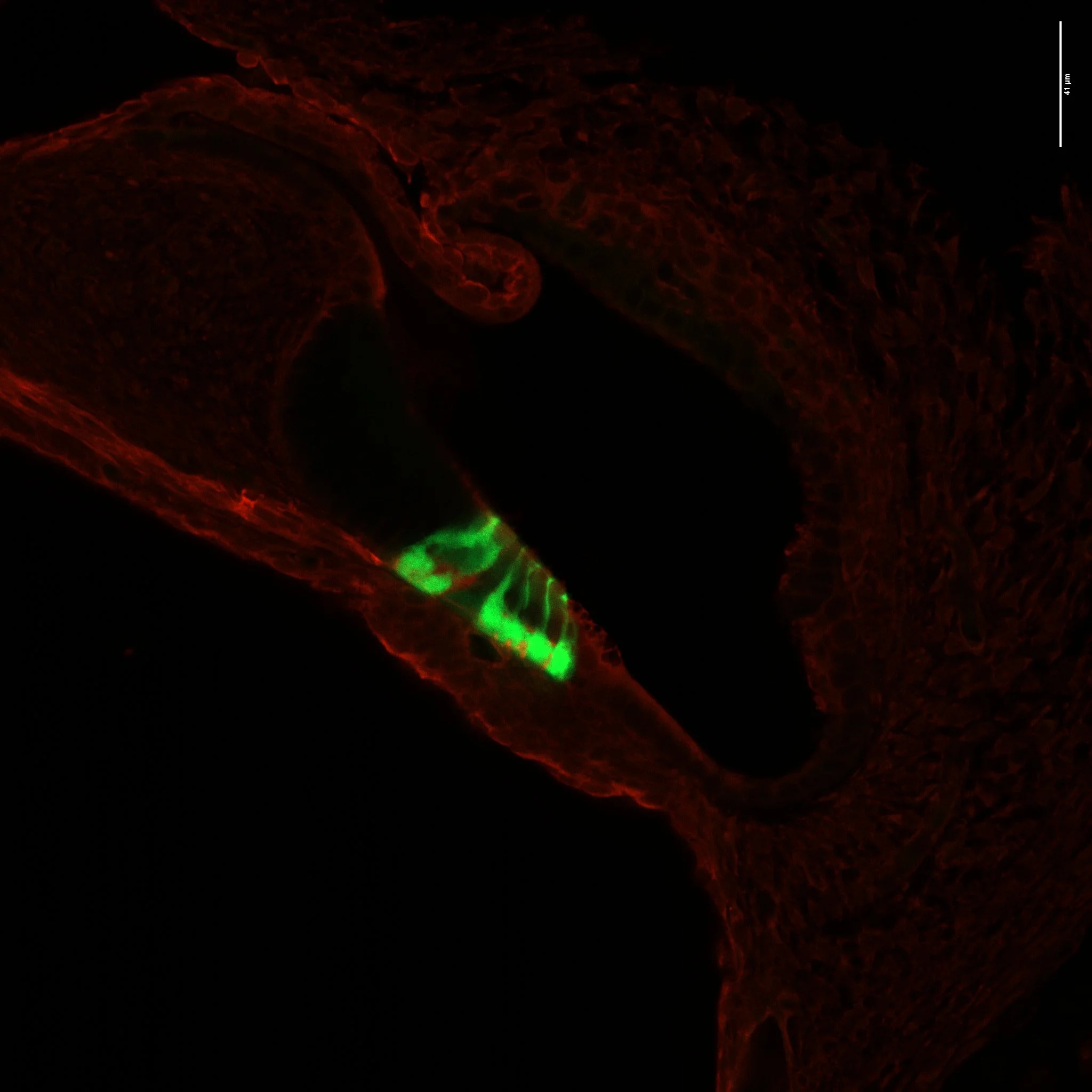
Transverse section of the organ of Corti from a P0 mouse cochlea. The supporting cells of the hair cells can be observed in green, while the labeling against the tubulin antibody (an essential protein for cell structure) is shown in red, being widely present in all cells of the sensory organ. . The image was taken during the Biology of the Inner Ear course at MBL in 2022.